Luca Pacioli After 500 Years And here's the press release:
On 21 October 2010, with the presentation of the Conference Proceedings of study 500 years after Pacioli (Sansepolcro, 22 and May 23, 2009 ) was Pacioli review of the achievements of the Project and were presented the results of two years of study and research, which involved students, teachers and students of secondary schools of the Tuscan and Umbrian Tiber Valley, with the cooperation of local authorities, and of individuals and companies operating in the Territory. The speakers were Professors James Banker, Argante Ciocci, Roberto Manescalchi, Enzo Mattesini, Pier Daniele Napolitani, Fausto Casi (Mostra A scuola di scienza e tecnica) e Giovanni Cangi (Quaderno Pacioli fra Arte e Geometria). Ha introdotto la Prof.ssa Paola Refice, Presidente della Fondazione Piero della Francesca. Ha condotto Matteo Martelli, Presidente del Centro Studi Mario Pancrazi. Nella Sala Conferenze della Fondazione Piero della Francesca, in Viale Aggiunti a Sansepolcro, il folto pubblico ha partecipato alla ricostruzione della figura intellettuale di Luca Pacioli ed ha avuto modo di constatare la validità scientifica del volume degli Atti. Dagli interventi degli studiosi e dei docenti è emerso che il volume del Centro Studi non solo rappresenta un aggiornamento importante delle conoscenze biografiche del frate del Borgo, ma raccoglie gli studi most up to date on the works of Francis, on behalf of its recognition to the language of science in late fifteenth and early sixteenth century, and illuminates the relationship between Piero and Luca Luca between Leonardo and, in the context of the statement of the mathematical sciences, Pacioli places the protagonist of the great revolution of printing with movable type. The book will be presented by the President of the Centre, November 10, 2010 in Leon in Spain, during the proceedings of the VII Encuentro Internacional AEC. For an audience of experts in accounting and business management, the development program will be shown the work of Pacioli promoted by local authorities, da Aboca Museum e dal Centro Studi “Mario Pancrazi”. Partendo dal Convegno del 1994 (Luca Pacioli e la Matematica del Rinascimento) sarà illustrata la bibliografia pacioliana fino al volume degli Atti. Un’attenzione particolare sarà rivolta alle pubblicazione delle Edizioni Aboca, dalla monografia pacioliana di Argante Ciocci (2009) all’edizione in facsimile di tre manoscritti del minorita di Sansepolcro: il De ludo scachorum (2007), il De viribus quantitatis (2009), il De divina proportione (manoscritto della Biblioteca Universitaria di Ginevra) del 2010. Il Centro Studi “Mario Pancrazi” nei prossimi mesi pubblicherà il terzo quaderno della Serie R&D diretta da Francesca Giovagnoli, the result of the seminar devoted to astronomy January 31, 2010 (Conference Room of the Diocesan Museum of Città di Castello) and will contribute to the realization, in cooperation with the Central Apennines Business - Review of Territory and boarding INPDAP "Regina Elena", the seminar entitled economy after the crisis - Labor / Business / Company (Theatre Hall boarding INPDAP, 3 and 4 December 2010). They are in the works, finally, two initiatives: the Leonardo Project and the Tiber Valley, which includes a seminar and to publish the papers by the end of 2011 and an International Meeting on June 19 in Sansepolcro that will take stock on the biography and on pacioliana 'importance Brother of mathematics in the history of accounting and business economics.
numbers and succession: metamathematical reflections, historical and educational activities on a song Leopardi (1) GIORGIO TOMASO BATHROOMS
1. Medley of thoughts, November 28, 1820 wrote the twenty-two Giacomo Leopardi: "The man without the knowledge of a speech, can not conceive the idea of \u200b\u200ba fixed number . Imagine you have thirty or forty stones, senz'avere a name to be given to each one, that is, one, two, three, to the last name, ie thirty or forty, which contiene la somma di tutte le pietre, e desta un'idea che può essere abbracciata tutta in uno stesso tempo dall'intelletto e dalla memoria, essendo complessiva ma definita ed intera. Voi nel detto caso, non mi saprete dire, né concepirete in nessun modo fra voi stesso la quantità precisa delle dette pietre; perché quando siete arrivato all'ultima, per sapere e concepire detta quantità, bisogna che l'intelletto concepisca, e la memoria abbia presenti in uno stesso momento tutti gl'individui di essa quantità, la qual cosa è impossibile all'uomo. Neanche it should help the eye, wanting to know why the number of certain objects present, and not knowing how to count, you need the same operation and simultaneous individual memory. So if you do not know except one numerical designation, and counting could not say more than one, one, one; to how much attention you would put, akin to collect progressively with the soul and memory The precise amount of these units until the last, you'd in the same case. So if I did not know that two other names etc.. Except a very small amount, like five or six, which memory and intellect can not conceive of speech, because you get to simultaneously present all it amounts to a few individuals ... Typically the idea of \u200b\u200bthe precise number, or with the help of speech or not, has never instantaneous, but composed of succession, more or less long, more or less difficult, according to the measure the amount (by Zibaldone of thoughts, 28 November 1820 : Leopardi, 1969). This track offers some reflections on the concept of natural number. First, it is clear the central importance that the author attributes to the language
(1). Early onset ("The man without the knowledge of a speech,
can not conceive the idea of \u200b\u200ba fixed number), in fact, Leopardi
explicitly refers to the essential role of the name of the individual numbers
natural: it is thanks to 'name' that we can enumerate the elements of a finite
(that we can identify, gradually, his
subsets of increasing cardinality) until you hear the whole
(to fix "an idea that can all be embraced in the same time
intellect and memory, but defined as total and complete ").
This concept is therefore closely linked to the numerical count, when
to enumerate: the role of the 'speech' is to be decisive in its
as it allows the unfolding of the proper implementation of such a measure ("And so if you do not
I knew except a single numerical designation, and counting
could not say no more than one, one, one ...»). Leopardi, towards the end of the passage quoted,
clearly recognizes that the very concept of numbers through (and beyond)
the succession of 'Name', is linked inextricably
to count ("The idea of \u200b\u200bthe exact number, or with the help of speech or not, is not
never instantaneous, but composed of succession) (Borg & Pepe, 1998).
This consideration can be modern and thorough recovery
by examining some of the settings of arithmetic, as we shall see that based on the introduction of recursive
their roots.
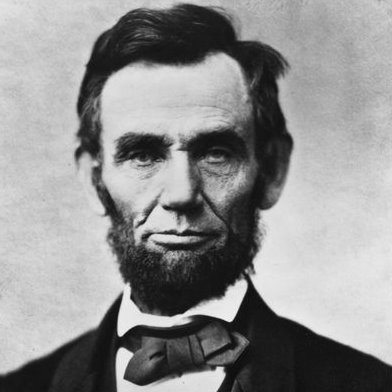
The Abraham Lincoln connection From site http://www.mathopenref.com/euclid.html
At age forty, Abraham Lincoln Studied Euclid for training in reasoning, and as a traveling lawyer on horseback, kept a copy of Euclid's Elements in his saddlebag. In his biography of Lincoln, his law partner Billy Herndon tells how late at night Lincoln would lie on the floor studying Euclid's geometry by lamplight. Lincoln's logical speeches and some of his phrases such as "dedicated to the proposition" in the Gettysburg address are attributed to his reading of Euclid.
Lincoln explains why he was motivated to read Euclid: "In the course of my law reading I constantly came upon the word "demonstrate". I thought at first that I understood its meaning, but soon became satisfied that I did not. I said to myself, What do I do when I demonstrate more than when I reason or prove? How does demonstration differ from any other proof?
I consulted Webster's Dictionary. They told of 'certain proof,' 'proof beyond the possibility of doubt'; but I could form no idea of what sort of proof that was. I thought a great many things were proved beyond the possibility of doubt, without recourse to any such extraordinary process of reasoning as I understood demonstration to be. I consulted all the dictionaries and books of reference I could find, but with no better results. You might as well have defined blue to a blind man.
At last I said,- Lincoln, you never can make a lawyer if you do not understand what demonstrate means; and I left my situation in Springfield, went home to my father's house, and stayed there till I could give any proposition in the six books of Euclid at sight. I then found out what demonstrate means, and went back to my law studies."